

Bartels Mikrotechnik
mp-Lowdriver Pump Driver
67.00€
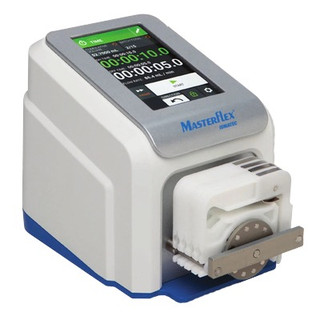
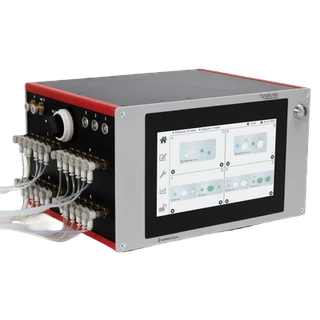
Hamilton Duo Syringe Pump, independent dual-drive syringe pump
Each drive gets its own syringe, flow rate and volume, all set up on one 7-inch touchscreen. Fit syringes from 0.5 µL to 50 mL, or pair two syringes on one drive when two liquids must move together.
New from Hamilton, November 2026. Configure your holders below, then order on the product page.

Designed and built by Hamilton, the maker of the syringes it drives.
Drag the pump to turn it around. The back panel carries the power, USB and footswitch connectors.

A stable benchtop layout with the syringe holders, touchscreen and fluidic connections all within reach. The one for routine runs and frequent syringe changes.
Dimensions from Hamilton’s spec sheet.
Select a number or a feature to see where it sits on the pump.

The flow range spans more than ten orders of magnitude. Where you sit on it depends on the syringe: the smallest reaches the lowest rate, the largest the highest.
Figures from Hamilton’s spec sheet. Limits given for a 0.5 µL syringe (0.103 mm bore) and a 50 mL syringe (32.573 mm bore). Scale illustrative.
The 7-inch touchscreen keeps the two drives apart, and turns with the pump when you stand it up.

Every pump ships with two single-syringe holders. Choose a holder for each drive: the summary lists the SKUs to order.

Each module extends what the pump can do without changing how you run it. Order them from their own product pages.

Switches the liquid path without taking the syringe off the pump, for filling and repeated transfers. The sensor flags restrictions and excessive back pressure.
View product page SKU HM-10209837
Detects air in transparent tubing and warns you before it reaches a sensitive downstream step.
View product page SKU HM-10209851 (Ø2 mm), HM-10209853 (Ø3 mm)
Starts and stops runs without touching the screen, when your hands are on samples or fluidic connections.
View product page SKU HM-10209843Pick your holders above, then open the product page to order the pump and the accessories on your list.
Hamilton designed the Duo for these research areas. The pump launched in November 2026, so published work with this model is still to come.
Low-volume flow into chips and cell-based models, with two liquids or two flow conditions from one instrument.
Stable direct infusion into analytical instruments, calibration and tuning, reagent addition and sampling.
Controlled reagent addition, ratio-based delivery and time-dependent dosing for reactions, formulation and electrospinning.
Research-only infusion and sampling in experimental models, including microdialysis.
| Performance | |
|---|---|
| Flow rate* | 4.97 pL/min with a 0.5 µL syringe to 220 mL/min with a 50 mL syringe |
| Accuracy | ±0.25% |
| Reproducibility | ±0.05% |
| Maximum linear force | 34 kgf (±15%), about 333 N (±15%) per drive at 100% force |
| Syringe size | 0.5 µL to 50 mL; up to 25 mL each on the Dual-Syringe Holder |
| Drive | |
| Drives | 2 independent stepper motors, 1.8° microstepper |
| Motor control | Microprocessor, 1/32 microstepping |
| Step resolution | 0.0579 µm/µstep |
| Step rate | 6 s/µstep (minimum) to 13.18 µs/µstep (maximum) |
| Interface | |
| Display | 7-inch TFT color touchscreen |
| Modes of operation | Simple mode, complex methods |
| Orientation | Horizontal or vertical, interface adapts |
| Connectors | Power barrel connector, USB Type-A, 3.5 mm footswitch jack |
| Real-time clock | Yes, with battery backup (battery included) |
| Physical and environment | |
| Dimensions (L × W × H) | 28.7 × 29.7 × 16.6 cm |
| Weight | 6.2 kg |
| Power supply | Input 100–240 VAC, 50/60 Hz; output 24 VDC, 2.71 A, 65 W |
| Operating temperature | 4 °C to 40 °C |
| Operating humidity | Up to 80% RH at 31 °C, decreasing linearly to 50% RH at 40 °C |
| Storage | −10 °C to 70 °C, 20% to 80% RH non-condensing |
| Compliance and ordering | |
| Certifications | CE, CSA, KC |
| EMC | Class B, tested for a basic electromagnetic environment per IEC 61326-1; pollution degree 2 |
| Intended use | Research use only. Not for diagnostic procedures or administration to humans. |
| SKU | HM-10212610: pump, 2 single-syringe holders, power cord for the country of destination |
| Accessories | Dual-Syringe Holder HM-10208930, Footswitch HM-10209843, Solenoid Valve with Pressure Sensor HM-10209837, Bubble Sensor for Ø2 mm tubing HM-10209851 or Ø3 mm tubing HM-10209853 |
*The range you can reach depends on the syringe fitted. Specifications from Hamilton’s spec sheet (Lit. No. 10213053, Rev. 0); subject to change without notice. SKUs from the Darwin Microfluidics catalog.
SKU HM-10212610 ships ready for two syringes, one on each drive.
You’ll also need syringes and tubing: see Hamilton syringes at Darwin Microfluidics. Dual-Syringe Holders and sensor modules are optional: see the options.
Yes. Each drive has its own syringe, flow rate and aspirate or dispense volume, so one channel can infuse while the other withdraws. You can also combine both drives in a coordinated two-channel method.
Use the Dual-Syringe Holder when two syringes must move together: both plungers advance at the same programmed speed, with syringes up to 25 mL each. Keep the syringes on separate drives when each flow needs its own rate or timing. With a Dual-Syringe Holder on each drive, you run two matched pairs, each pair controlled independently.
The pump is optimized for Hamilton syringes from 0.5 µL to 50 mL, which are in its built-in syringe library. For a compatible third-party syringe, you can save a custom profile so the pump calculates flow from its dimensions. Third-party syringes must meet Hamilton’s dimensional, mechanical and material requirements, and checking the complete fluidic setup stays with the user. Send us your references and we’ll check them with you.
Hamilton specifies 4.97 pL/min with a 0.5 µL syringe (0.103 mm bore) and 220 mL/min with a 50 mL syringe (32.573 mm bore). In between, the range depends on the syringe: the narrower the bore, the lower the flow. Tell us your target flow and we’ll suggest a syringe.
Each drive pushes up to 34 kgf, about 333 N (±15%), with force set to 100%. Whether that is enough depends on the liquid, the syringe and the resistance of your tubing or chip. Send us those details and we’ll check before you order.
Hamilton’s spec sheet lists a USB Type-A port, a 3.5 mm footswitch jack and a power connector, but its launch documentation does not describe remote control from a computer. If your setup depends on it, ask us and we’ll confirm with Hamilton. For hands-free starts and stops, there is the footswitch.
On-screen notifications flag setup issues, finished runs and abnormal conditions, and the LED status bar shows when the pump needs attention. With the optional pressure or bubble sensors, the pump can also stop the affected operation when it detects an abnormal condition, and alert you.
No. The Duo is for research use only: it is not intended for diagnostic procedures or for administration to humans. Infusion and sampling in experimental models, such as microdialysis, are among the research uses Hamilton designed it for.
The product page has the ordering options for the pump and its accessories.

Get the latest updates on new products and upcoming sales